The Conceptual hierarchy: What is it?
Note: This paper documents my earlier understanding of the nature of the hierarchy. Since then, as all knowledge acquisition is a process, my theory on the precise nature of the hierarchy has evolved a great deal. This first attempt was markedly deductive as opposed to my far more advanced current views which are the result of an inductive approach. Also, I owe a great debt to Aristotle's Organon. I will publish a new and vastly improved explanation here in the future.
For my current thinking on Epistemology and the conceptual hierarchy, please see the following:
Epistemology-Aesthetics Study Group
Founded by Frederick C. Gibson and Alleyne RogersEASG Conceptual Dictionary and Hierarchy - in progress by Frederick C. Gibson
"'Hierarchy,' in general, as the Oxford English Dictionary reports, means 'a body of persons or things ranked in grades, orders, or classes, one above another.' A hierarchy of knowledge means a body of concepts and conclusions ranked in order of logical dependence, one upon another, according to each item's distance from the base of the structure. The base is the perceptual data with which cognition begins." (OPAR 131)
 I. First-level concepts
In discussing the relationship between the concept table and furniture, Rand states that furniture is the "wider" concept, because the concept table is subsumed in the concept furniture. What does Rand mean by the concept wider? She does not explicitly state that wider means higher, but this is being assumed by most of my opposition. My question is: why assume that wider means higher?
What are the widest possible concepts? They are existent, consciousness and identity. These three concepts subsume all existents, sensations, and all mental processes that were, are, and ever will be. They are axiomatic concepts, irreducible primaries. They can only be defined ostensively.
"Axioms are usually considered to be propositions identifying a fundamental, self- evident truth. But the explicit propositions as such are not primaries: they are made of concepts. The base of man's knowledge - of all other concepts, all axioms, propositions and thought - consists of axiomatic concepts. An axiomatic concept is the identification of a primary fact of reality, which cannot be analyzed, i.e., reduced to other facts or broken into component parts. It is implicit in all facts and in all knowledge. It is the fundamentally given and directly perceived or experienced, which requires no proof or explanation, but on which all proofs and explanations rest." (ITOE 55)
The axiomatic concepts are the base of all conceptual knowledge. They alone are level 1 in the conceptual hierarchy and can only be defined ostensively. The axiomatic concepts are grasped fully in the minds of adults. The question "What is it?" or "What is the identity of that existent?" subsumes all three axiomatic concepts. The following question arises, how are children able to form the axiomatic concepts if all conceptualization starts with these very concepts?
II. Implicit concepts The concept formation process is a *process*. It is not automatic. The process takes time, even though in some cases it can be an extremely short or long duration of time. Before a child can form his first concept, he must begin the formation of the three axiomatic concepts. At this early stage of a child's development, these concepts are still in the *process* of conceptualization, and are considered implicit knowledge.
"Now what I say is: before your conscious apparatus, the faculty of consciousness, is aware of something, it is not conscious, and certainly there is no 'I.' But when you become aware, implicit in your first sensation are certain axiomatic concepts. And they are what? That you exist, that the outside world exists, and that you are conscious. The baby could not conceptualize this, but it's implicit; without that implication he couldn't be aware of anything." (ITOE 253)
"The (implicit) concept "existent" undergoes three stages of development in man's mind. The first stage is a child's awareness of objects, of things - which represents the (implicit) concept "entity." The second and closely allied stage is the awareness of specific, particular things which he can recognize and distinguish from the rest of his perceptual field - which represents the (implicit) concept "identity." The third stage consists of grasping relationships among these entities by grasping the similarities and differences of their identities. This requires the transformation of the (implicit) concept "entity" into the (implicit) concept "unit". (ITOE 6)
III. Definitions All existents which satisfy the conceptual requirements identified by the definition are either units of the concept being defined or units of a higher level concept. When the conceptual context identified by the definition subsumes *all* the essential characteristics of a given existent, then that existent is a unit of the defined concept.
The definition's genus serves as the link to the conceptual context on which the defined concept depends. In other words, by identifying the definition of the genus concept, which is hierarchically one level below the defined concept, another genus and differentia are obtained. If this reduction process is continued, one will eventually arrive at an irreducible concept, an axiomatic concept, at which point a direct connection to existence/consciousness is obtained. Then, using all the differentia isolated through the reduction process, a complete conceptual context is obtained which fully identifies the essential nature of the units subsumed under the defined concept.
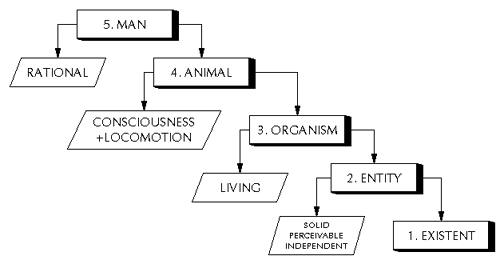
IV. Examples 1. Man
The conceptual chain linking "Man" to reality is (with differentia in parentheses):
Man--->
(Rational) Animal--->
(Consciousness/Locomotion) Organism--->
(Living) Entity--->
(Solid/Perceivable/Independent) ExistentIn sentence form (with hierarchical level in parentheses):
A Man(4) is a living entity(1) with the faculties of consciousness and locomotion (2) and possessing a rational faculty(3).
Therefore, "Man" is a forth level concept.
2. Table
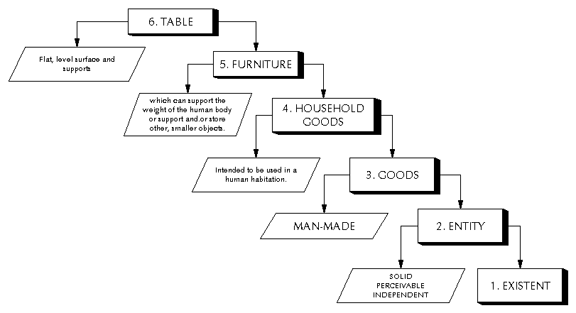
(Note Rand's discussion of the concept "table" (ITOE 177-181))
The conceptual chain linking "table" to reality is (with differentia in parentheses):
Table--->
(Flat, level surface and supports) Furniture--->
(Able to support the weight of the human body or support and/or store other, smaller objects.)Household goods--- >
(Intended to be used in a human habitation) Goods--->
(Man-made) Entity--- >
(Solid/Perceivable/Independent) ExistentIn sentence form (with hierarchical level in parentheses):
A table(5) is a man-made entity(1) intended to be used in a human habitation(2) which can support the weight of the human body or support and/or store other smaller objects(3) with a flat, level surface and supports(4).
Therefore, "table" is a fifth-level concept.
V. Selected source material An entity is a solid existent "open to human perception and capable of independent action." (Peikoff TPO lecture 3 question period)
Implicit Knowledge
"The building-block of man's knowledge is the concept of an "existent" - of something that exists, be it a thing, an attribute or an action. Since it is a concept, man cannot grasp it *explicitly* until he has reached the conceptual stage. But it is implicit in every percept (to perceive a thing is to perceive that it exists) and man grasps it implicitly on the perceptual level - i.e., he grasps the constituents of the concept "existent." the data which are later to be integrated by that concept. It is this implicit knowledge that permits his consciousness to develop further." (ITOE 5)
"Axiomatic concepts identify explicitly what is merely implicit in the consciousness of an infant or of an animal. (Implicit knowledge is passively held material which, to be grasped, requires a special focus and process of consciousness - a process which an infant learns to perform eventually, but which an animal's consciousness is unable to perform.) (ITOE 57)
Implicit vs. Explicit knowledge
(Note the discussion "Implicit Concepts" ITOE 15)
"The "implicit" is that which is available to your consciousness but which you have not conceptualized. For instance, if you state a certain proposition, implicit in it are certain conclusions, but you may not necessarily be aware of them, because a special, separate act of consciousness is required to draw these consequences and grasp conceptually what is implied in your original statement. The implicit is that which is available to you but which you have not conceptualized." (ITOE 159)
"An implicit concept is the stage of an integration when one is in the process of forming that integration and until it is completed." (ITOE 162)
"An implicit concept is the stage, that period of time whatever it might be, when a child is actually focusing on a certain group of concretes, isolating them from the rest of his field, and/or integrating them. And that's not all done instantaneously: it is a process. It is in that process that the future concept is implicit." (ITOE 162)
UNITS
"A unit is an existent regarded as a separate member of a group of two or more similar members." (ITOE 6)
"Thus the concept 'unit' is a bridge between metaphysics and epistemology: units do not exist qua units, what exists are things, but units are things viewed by a consciousness in certain existing relationships." (ITOE 7)
CONCEPT
"A concept is a mental integration of two or more units possessing the same distinguishing characteristic(s), with their particular measurements omitted." (ITOE 13)
Conceptual Common Denominator (CCD): "The characteristic(s) reducible to a unit of measurement, by means of which man differentiates two or more existents from other existents possessing it." (ITOE 15)
|
|||||
|
HOME |
CONTACT |
GUEST BOOK |
SERVICES |
RESOURCES |
|
|||||
| Copyright © 1995-2009 | Frederick Clifford Gibson Architect & Associates |
| San Francisco, California - USA |
References
|